

If you have encountered marketing claims asserting that an intravenous cell infusion can “roll back your brain age by 13 years” or make your immune system years younger, those statements deserve careful scientific scrutiny.
What did researchers actually measure? Did the participants receive a standardized Muse cell product alone? Was there a parallel control group of patients who did not receive the infusion? Most importantly, did anyone demonstrate clinically meaningful improvements in strength, memory, or organ function—or merely a transient shift in a commercial surrogate biomarker test?
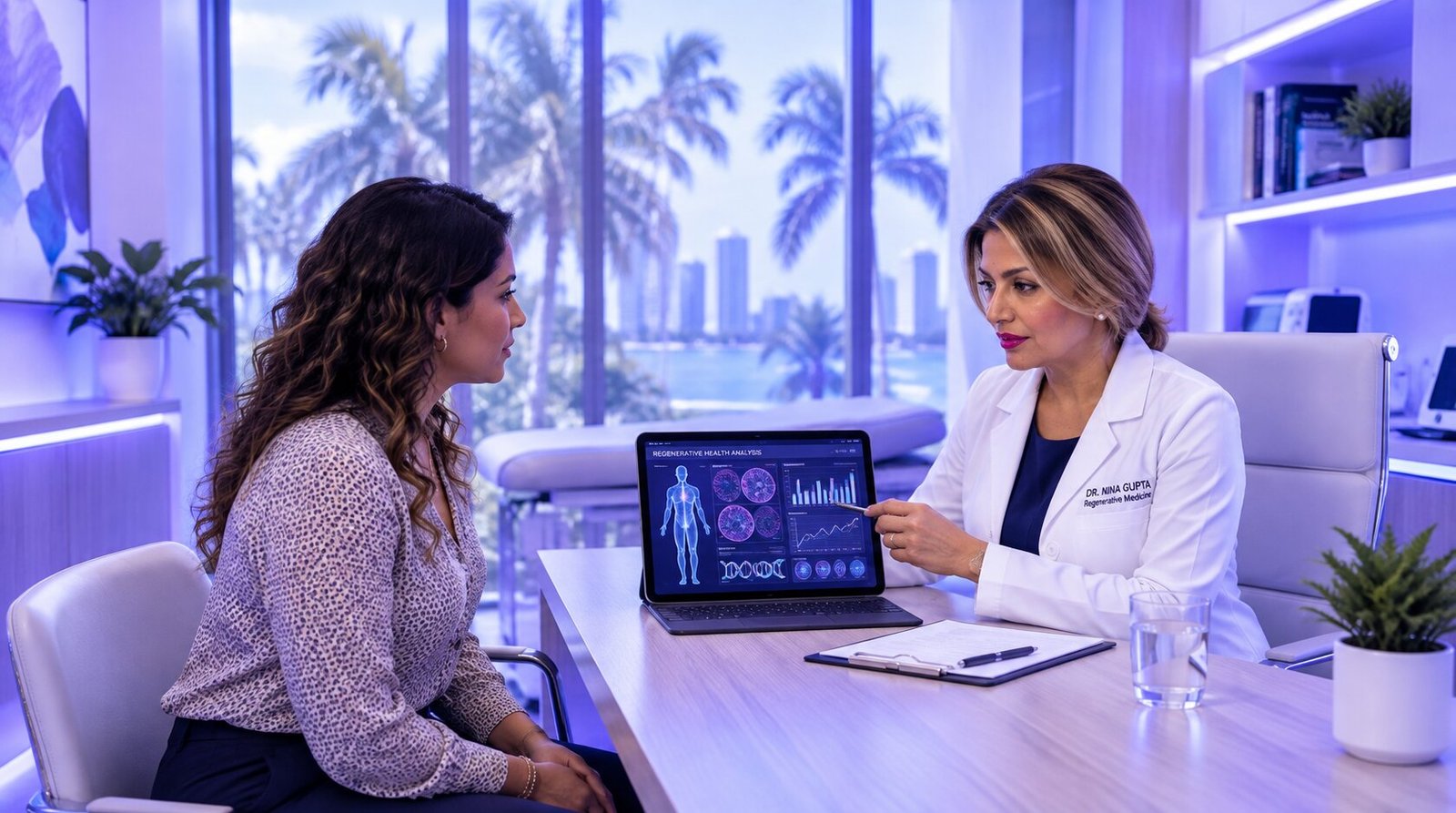
At Longevity Institute Miami, Dr. Nina Gupta approaches emerging cellular science with medical rigor: separating exciting laboratory discoveries from proven human therapies.
What Are Muse Cells?
Muse stands for multilineage-differentiating stress-enduring cells. Originally discovered in adult human mesenchymal tissues and bone marrow preparations by Kuroda and colleagues in 2010, Muse cells represent a unique subpopulation of non-tumorigenic adult stem cells.
In preclinical laboratory models, Muse cells are characterized by their expression of the embryonic cell surface marker SSEA-3 (Stage-Specific Embryonic Antigen-3), exceptional tolerance to harsh physiological stressors (including enzymatic digestion and hypoxia), and an intrinsic ability to differentiate across multiple tissue lineages.
Preclinical Homing vs. Human Anti-Aging Reality
Scientists are investigating how Muse cells detect biochemical homing signals (like sphingosine-1-phosphate) and migrate toward damaged tissue in experimental animal models. While scientifically fascinating, animal and in vitro findings cannot be extrapolated to mean that an intravenous infusion will automatically locate every aging organ in a human body, regenerate healthy tissue, or extend healthspan.
For a detailed exploration of Muse cell biology, manufacturing requirements, and Florida regulatory parameters, read our comprehensive service guide on Muse Cell Research & Physician Consultation in Miami.
Where Did the “Age Reversal” Claim Come From?
Much of the recent popular media enthusiasm surrounding Muse cells and biological age reduction originates from a 2025 case report published by Khan and Malik. The authors described two adult patients whose scores on a commercial DNA methylation–based epigenetic test changed after receiving a combination intervention.
The report noted calculated decreases in specific organ-specific “biological age” algorithms (including claims of a 13-year reduction in a brain-age model in one patient). While these observations are documented, they do not constitute scientific proof that Muse cells reverse the human aging process:
Critical Scientific Limitations of the 2025 Case Report:
- Sample Size of Only Two Patients: With an n = 2 and zero control or placebo comparison subjects, natural biological variability and placebo effects cannot be ruled out.
- Confounded Combination Therapy: Participants did not receive Muse cells alone; they received a multi-agent cocktail including Muse cells, Muse-derived exosomes, and umbilical cord plasma. It is scientifically impossible to determine which component (if any) influenced the test readings.
- Epigenetic Clocks Are Surrogate Algorithms: DNA methylation scores are mathematical models. A downward shift on a commercial software test does not prove restored organ histology, preserved cognitive capacity, or extended lifespan.
- Short-Term Follow-Up: The report provides no data showing whether the score changes persisted over time or translated into reduced disease incidence.
The authors of the paper explicitly noted these limitations, acknowledging test-retest variation, the lack of parallel comparison clocks, and the inability to exclude concurrent diet and lifestyle factors. Describing a patient as having “reversed brain age by 13 years” reflects a statistical estimate from a computer model, not clinical evidence of anatomical rejuvenation.
Does a Lower Biological Age Score Mean Someone Is Healthier?
Commercial biological age tests analyze specific cytosine methylation patterns on leukocyte DNA to estimate population-level aging trajectories. While these tools are valuable exploratory markers in academic geroscience, their outputs are not interchangeable with clinical health or additional years of disease-free life.
Different commercial test platforms analyze different CpG sites, leading to wildly divergent “age” estimates from the same blood sample. Furthermore, an epigenetic score can fluctuate significantly following acute viral illness, heavy exercise, systemic inflammation, or changes in white blood cell ratios.
For any longevity intervention to be considered validated, clinical studies must demonstrate tangible patient-centered outcomes: preserved muscle strength, maintained bone density, stable cognitive performance, reduced cardiovascular events, and extended independence in daily living. No controlled human trial has demonstrated these outcomes for Muse cells in healthy adults.
What Have Human Muse Cell Clinical Trials Actually Studied?
Legitimate human research on Muse cells has focused exclusively on acute, severe medical conditions using characterized, laboratory-grade investigational products:
Subacute Ischemic Stroke (Niizuma et al., 2023)
A randomized, double-blind, placebo-controlled trial in Japan evaluated CL2020 (a defined, donor-derived Muse cell product) in 35 participants recovering from subacute ischemic stroke (25 received CL2020, 10 received placebo).
At 12 weeks, 40% of the CL2020 group achieved functional independence (modified Rankin Scale ≤ 2) versus 10% in the placebo group, with an uncertain between-group statistical trend (p = 0.080).
Amyotrophic Lateral Sclerosis (Yamashita et al., 2023)
An early-phase, open-label study evaluated repeated intravenous infusions of CL2020 in five patients with ALS.
While the infusions were tolerated without immediate acute toxicity, changes in functional ALSFRS-R scores did not achieve statistical significance. The authors concluded that larger, blinded studies are necessary to evaluate efficacy.
Acute Myocardial Infarction & Cervical Spinal Cord Injury
Other small-scale human trials have explored intravenous Muse cells in acute ST-segment elevation myocardial infarction (Noda et al., 2020) and subacute cervical spinal cord trauma (Koda et al., 2024). These studies addressed specific post-injury windows in hospital settings; none established a therapy for general healthy aging, memory preservation, or routine fatigue.
Is the Muse Cell Product Offered by a Clinic the Same as CL2020?
You cannot determine the biological safety or clinical efficacy of a cellular product from marketing terminology alone. Published clinical trials rely on strict cell-line characterization, donor qualification, validated SSEA-3 surface marker sorting, sterile GMP manufacturing standards, exact viable cell dosing, and defined cryopreservation protocols.
A generic stem cell vial, an uncharacterized mesenchymal stromal cell (MSC) preparation, or birth-tissue derivative obtained from a commercial vendor is not equivalent to CL2020. Citing the Japanese stroke trial to market an uncharacterized clinic infusion for knee arthritis or wellness is scientifically invalid.
Furthermore, patients should understand the distinct biological differences between cellular therapies:
- Platelet-Rich Plasma (PRP): Autologous concentrated platelets and growth factors derived from your own blood—not Muse cells. Explore Regenerative Medicine in Miami.
- Exosomes: Acellular extracellular vesicles containing signaling proteins and RNA—not living, self-renewing Muse cells.
Are Muse Cells Approved for Anti-Aging in the United States?
As of September 2026, no Muse cell product is approved by the U.S. Food and Drug Administration (FDA) for anti-aging, longevity, joint restoration, dementia prevention, or general wellness.
FDA Consumer Alerts & Regulatory Context
The FDA maintains a standing Consumer Alert on Regenerative Medicine Products, warning patients that unapproved stem cell and exosome products marketed for degenerative conditions may lack established proof of safety or effectiveness. (The FDA's 2024 approval of Ryoncil applies exclusively to pediatric steroid-refractory acute graft-versus-host disease and does not apply to Muse cells or anti-aging indications.)
Under Florida law, Florida Statutes §458.3245 addresses specific physician parameters for certain non-FDA-approved stem cell therapies within authorized scopes such as orthopedics, wound healing, or pain. It does not grant blanket authorization to market unproven cell therapies for biological age reversal, cognitive enhancement, or cardiac longevity.
What Would Convincing Longevity Evidence Look Like?
To legitimately claim that a cellular therapy extends human healthspan, researchers must conduct rigorous, high-quality clinical trials that satisfy essential scientific standards:
- Adequately Powered, Randomized Control Groups: Comparing hundreds of matched participants receiving the characterized cell product against an identical placebo group.
- Hard Functional Endpoints: Directly measuring physical grip strength, VO₂ max, cognitive memory batteries, arterial stiffness, and bone density over 2 to 5+ years.
- Transparent Safety Tracking: Systematically reporting adverse events, microvascular risks, ectopic tissue formation, and immune reactions.
- Separation of Confounding Agents: Testing the pure cellular candidate in isolation rather than co-administering plasma or exosomes.
Dr. Gupta’s Clinical Approach to Emerging Longevity Treatments
At Longevity Institute Miami, Dr. Nina Gupta begins with the person in front of her—your unique cardiovascular profile, family history, symptoms, and healthspan goals.
When patients ask about Muse cells, Dr. Gupta conducts an unhurried, evidence-based review of their medical records and the specific clinical claims they have seen. She evaluates whether published human research involves the identical product, diagnosis, and delivery method, while discussing known safety profiles and regulatory status.
Proven Foundations of Healthspan Optimization:
For individuals interested in genuine healthy aging, the highest-impact clinical priorities are firmly rooted in established science:
- Cardiometabolic Risk Reduction: Optimizing ApoB, blood pressure, fasting glucose, and visceral fat distribution. Explore Healthy Aging & Healthspan Care.
- Musculoskeletal Preservation: Progressive resistance training and targeted nutrition to protect metabolic rate and physical mobility.
- Restorative Sleep & Autonomic Balance: Screening for sleep apnea, optimizing circadian rhythms, and reducing chronic neuro-inflammatory stress.
*A medical consultation provides unbiased scientific evaluation and education; it does not imply that Longevity Institute Miami administers an unapproved Muse cell infusion or injection.